


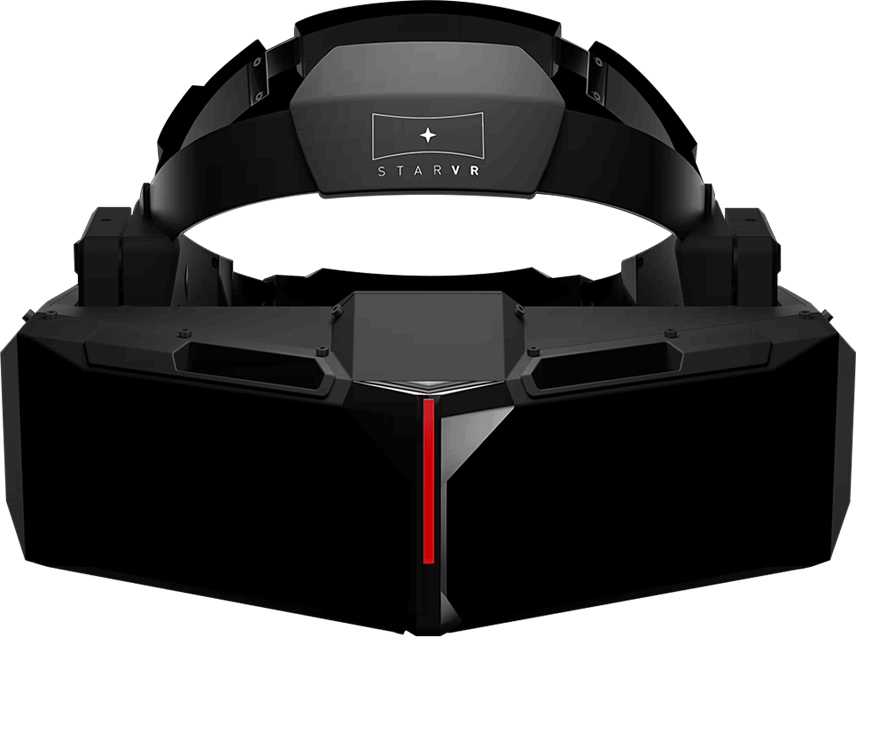
The StarVR headset has the highest field-of-view value among VR headsets currently in development. Photo: StarVR/Starbreeze Studios
The human eye perceives its surroundings with incredible clarity, depth, and a wide field of view. To put in perspective with technicality, the human eye can perceive a field of view of up to 180 degrees without even moving the eyeballs. Even more, the eyes can see up to a 270-degree field of view, given that the eyes are fully rotated. These amazing facts about the human eye are one of the key things that VR headsets are taking into consideration. By creating a wide field of view, VR headsets can offer great immersion and depth of view to every content it renders to the user.
Although many VR headsets offer a wide field of view, the human eye has such great abilities to detect imperfections in vision. A visual phenomena called tunnel vision occurs while wearing such headsets. Because the human eye has a great perception of its field of view, VR headsets cannot fully envelop the eyes’ view field. Basically, even a VR headset with a 180-degree field of view will create some perceptible differences in rendering a virtual environment compared to the physical world. The tunnel vision effect is also called the “snorkel mask effect”, since it is very much similar to what we experience when we use snorkeling masks in water.
VR headsets boast of field of view specifications varying from one to the next. For the sake of comparison, the StarVR headset has the highest FOV value of any VR headset in development yet, with an extra wide viewing angle of up to 210 degrees – even surpassing that of the VR Union Claire which also offers a wide field of view of 170 degrees. By offering up to 210 degrees, StarVR extends the viewing experience beyond the human eye’s peripheral vision. The entire VR experience greatly depends on the field of view, though other specifications must also be met. Here’s a table showing VR headsets currently in development, with their corresponding field of view values:
| VR Headset | Field Of View (degrees) |
|---|---|
| StarVR | 210 |
| VR Union Claire | 170 |
| Wearality Sky | 150 |
| GameFace Labs VR | 140 |
| ImmersiON-VRelia BlueSky PRO | 123 |
| Oculus Rift (Development Kit 1) | 110 |
| HTC Vive | 110 |
| Dlodlo VR Glasses | 110 |
| Visus VR | 110 |
| Cmoar | 105 |
| Vrvana Totem | 105 |
| FOVE | 100 |
| Oculus Rift (Development Kit 2) | 100 |
| Sony Project Morpheus | 100 |
| Dior Eyes | 100 |
| AirVR (iPad mini) | 100 |
| Homido | 100 |
| Xingear XG VR | 100 |
| Pinch VR | 100 |
| Razer OSVR | 100 |
| Zeiss One VR | 100 |
| Samsung Gear VR | 96 |
| AirVR (iPhone) | 90 |
| Durovis Dive 5 | 90 |
| Google Cardboard | 90 |
| Impression Pi | 90 |
| Viewbox | 90 |
| Avegant Glyph | 45 |
Field of view values for VR headsets are essential to what one should expect in a VR experience. Generally speaking, a higher value can nearly eliminate the so-called snorkel mask effect. Other factors that affect the tunnel vision phenomena include the structure of the VR headset itself, and the shape of the lens or screen. Some VR headsets use Fresnel lens technology, such as the Pinch VR and the Wearality Sky, which keeps the form factor thin while also offering a wide field of view. So if you are thinking about getting a VR headset soon, keep in mind that field of view values are key to getting a terrific virtual reality experience, and is a good deciding factor in choosing a VR headset that suits you well.
0 التعليقات:
إرسال تعليق